Vermont Veterinary Medical Association and Berkshire Medical Association In-Person Continuing Education and Social Event
Thank You to Our Generous Sponsors for a Great Evening of Collegiality and Learning!

 
The VVMA is excited to present a Telemedicine/ Telehealth Informational CE Series
Offered as a Joint Initiative by the New England VMAs at Special Reduced Pricing!
Presented by Dr. Lori Teller, ABVP (Canine and Feline Practice)
Telemedicine: How Can I Implement It in Practice?
Livestream on Wednesday, September 30 at 7:00 PM
On-demand Viewing Available after the Livestream
Webside Manner: The Art of Telemedicine
Livestream on Wednesday, October 14 at 7:00 PM
On-demand Viewing Available after the Livestream
Ethical Issues with Veterinary Telehealth
Livestream on Wednesday, November 18 at 7:00 PM
On-demand Viewing Available after the Livestream
Choose to register for one, two, or all three programs
Registration and More Information
Upcoming Webinar for the CT VMA THIS Wednesday:
Introducing the VVMA Peer Practice Observation and Collaboration Program, an initiative designed to foster collaboration, mentorship, and professional growth among members
For more information, click here to learn more about this this program which provides VVMA members the opportunity to visit one another’s practices and learn from one another
The Blocked Tom: Practical Management of Feline Urethral Obstruction- 2 CE Hours With Dr. Mark Besancol
Implementing Ultrasound in the Diagnosis of Feline Lower Urinary Tract Diseases and other Feline Topics- 3 CE Hours with Ashlie Saffire, DVM, DABVP (Feline)
Doing the Right Things for the Right Reasons in Effective Pain Management- 3 CE Credits Including Ethical Obligations to Provide Fear Free™ and Cat Friendly© Experiences as well as Palliative and End-of-Life Care - -Just Because We Can, Does That Mean We Should? Presented by Dr. Robin Downing, Doctor of Veterinary Medicine, Doctor of Bioethics and a pioneer in both modern veterinary pain management, as well as the translation of palliative and end-of-life care principles and practices from human medicine for application in clinical veterinary practice
The Intelligence Shift: Navigating the Future of Veterinary Care with AI- 1 CE Credit- Presented by Aaron Massecar, PhD, MBA of CO.VET
-Surgical Spectrum of Care Basics: What Do We Really Need?- 1.5 CE Credits
-General Practice Orthopedics Starter Kit - Theory, Nuts, and Bolts- 1.5 CE Credits
-Your Dermis Is Showing - Traumatic Wounds From Inflicted to Healed/ Gut Check - When To Cut The GI Tract, Where, and How- 2 CE Credits
-When Tension is High - Surgical Gymnastics to Close Large Wounds- 1 CE Credit
All of the above presented by Dr. Ingar Krebs, DVM, DACVS, Senior Director, Medicine & Surgery, ASPCA Spay/Neuter Alliance
Save the Date- VVMA Two Day Winter 2027 Two Day Winter Meeting- March 6 and 7, 2027
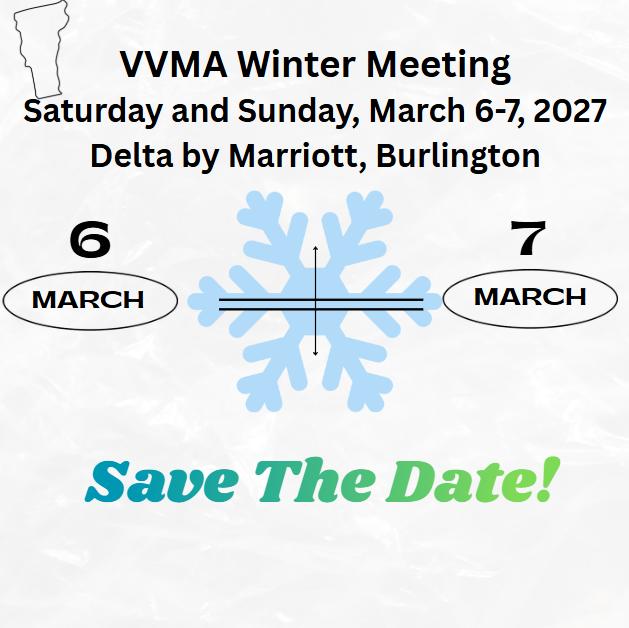 Delta Hotel Marriott, South Burlington, VT Delta Hotel Marriott, South Burlington, VT
Small Animal, Bovine and Equine Programming- Details coming in the fall
DEA Compliance CE to be offered during the Saturday Luncheon this year
A special ECHO Museum After-Dark Post Conference Event to be offered Saturday evening, March 6th!!
Mark your calendars!!!
Winter 2026 Program- Thank you Attendees, Sponsors, Exhibitors, and Speakers!!!
Thank you Platinum Sponsor
Thank you Silver Sponsors
  
Thank you Bronze Sponsor

The Equine Program Made Possible By The Generous Sponsorship of:

Be sure and Follow Us on our new Instagram Page @vt_vma
Your voice matters! The VVMA thrives because of engaged members like you.
Join a committee, lend your creativity to our social media, or help shape upcoming conferences and member events. Get involved— strengthen your network, grow your leadership skills, and help move veterinary medicine forward in Vermont. Contact [email protected] to find out how you can get involved.
New World Screwworm: Veterinary Considerations for Dogs and Cats that Travel Internationally
Please review a new resource for veterinarians, https://www.aphis.usda.gov/sites/
default/files/nws-vet-guidance-cats-dogs.pdf, which outlines important companion pet (e.g., dogs and cats) health considerations and U.S. entry requirements for animals who travel to a NWS-affected country. This is especially pertinent to Vermont veterinarians, pet owners, and those who work with companion animals as the most likely route of introduction of New World Screwworm to VT would be through importation of companion animals. For more resources on NWS, visit www.screwworm.gov.
Know The Health Risks When Raising Backyard Birds
If you have clients considering raising backyard poultry, please guide them to the following Vermont Department of Health resource in which Dr. Natalie Kwik outlines important steps to help keep individuals healthy. In the article, individuals are reminded that children less than 5, individuals with weakened immune systems, and seniors are are more likely to get severe illness from the germs that poultry can carry, including Salmonella, Campylobacter, E. coli and avian influenza. Additional avian influenza precautions are also noted in the article. Since 2022, there have been five backyard flocks impacted by H5N1 in Vermont
New World screwworm (NWS) Myiasis Information
New World Screwworm is typically a disease of animals, especially livestock, but can also affect wildlife, pets, and people. Mexico and countries in Central America are reporting cases of NWS in both animals and people. Animals and people may be at an increased risk for NWS infestation if they were in areas where the flies are present, particularly in near infested livestock or other infested animals.
Some steps you can take to prevent infestation:
- Watch for signs of NWS in pets and livestock
- Make sure pets traveling internationally are inspected for screwworm
- Protect pets and livestock from other wound-causing parasites such as ticks
If you think you have found a screwworm, report it immediately to your State animal health official. This will allow USDA-APHIS and partner agencies to respond quickly and remove the screwworms before a population becomes established
Resources:
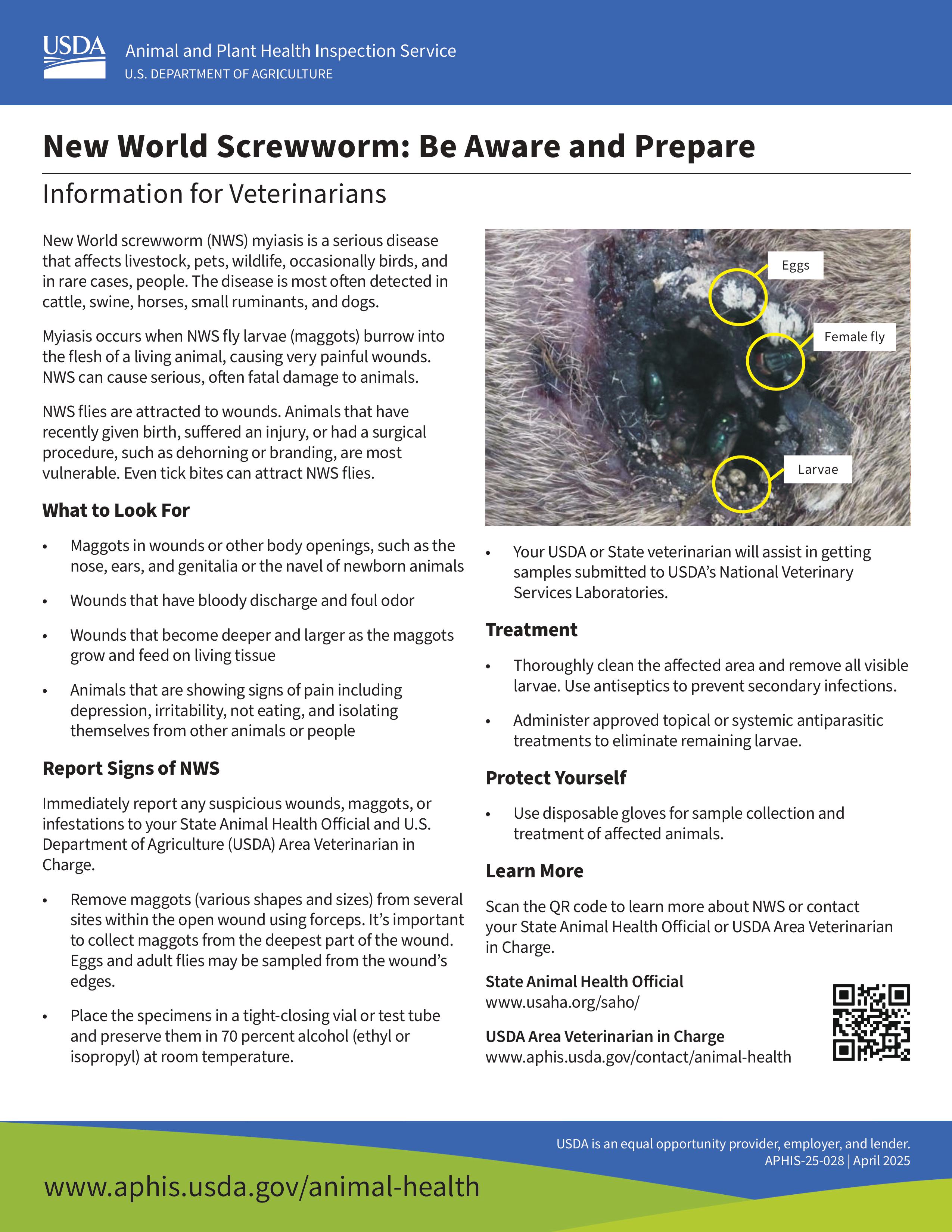 New World Screw Worm Information New World Screw Worm Information
Please use this link for the most updated information on New World Screw Worm. It contains information from the USDA's coordinated One Health response to combat NWS and has information specifically for veterinarians, livestock producers, pet owners, researchers, healthcare providers and the general public.
Veterinarians, please make use of this great fact titled New World Screwworm: Be Aware and Prepare. Please download this sheet made available by USDA APHIS containing information on what to look for, how to report signs of NWS, and information on how to learn more about the disease.
As a reminder, New World Screw Worm is primarily a risk to livestock and pests and the threat to humans and pets in very low, particularly in the Northeast.
Information from the AVMA Regarding the Department of Education's Proposed Rule Changes for Accreditation:
Please click on the following links for :
AVMA's public comments to the Department of Education
AVMA's Letter to Colleagues Regarding Understanding of the Accreditation Changes
Eastern Equine Encephalitis (EEEV) Update from the Vermont Department of Health
Please see this letter sent out July 15 from Vermont State Public Health Veterinarian Natalie Kwit regarding Eastern equine encephalitis virus (EEEV). Vermont recently experienced its highest level of EEEV activity on record, and as mosquito activity increases, the Vermont Department of Health is asking for your partnership in preventing illness through vaccination, identifying suspected cases, and submitting specimens for testing. Specific instructions for testing, including sample submission, are detailed in the letter.
National Association of State Public Health Veterinarians Position Statement On Rabies Vaccination
Please see the Position Statement released by the NADSPHV Supporting Vaccination Against Rabies for Dogs and Cats. In the position statement it is stated that "NASPHV encourages state and local authorities to establish policies and programs that help to prevent and control rabies, including those that require owners to protect their animals through regular rabies vaccination". It is encouraged to share this position statement with clients, policy makers, constituents, and the public at large.
New Webinar Provides Latest Guidance on New World Screwworm- 1 free CE Credit
New World screwworm: Detect, prevent, and treat presents the latest information from the U.S. Department of Agriculture, Food and Drug Administration, and Centers for Disease Control and Prevention to help promote understanding of New World Screwworm to help veterinarians detect, prevent, and treat infestations. This resource delivers the latest guidance on NWS offers one Continuing Education (CE) credit for participants. Please Click Here to access this FREE webinar
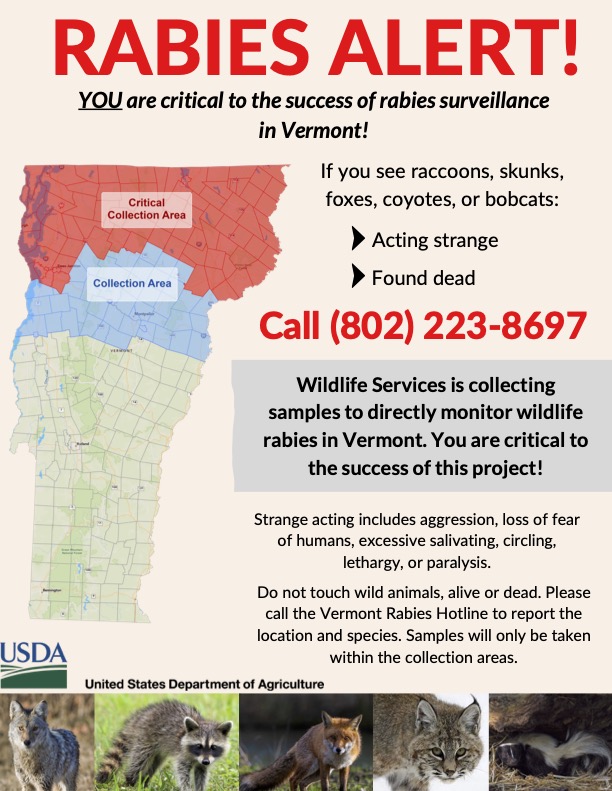
IMPORTANT INFORMATION ABOUT RABIES FROM USDA WILDLIFE SERVICES
In Vermont, USDA works with the Vermont Department of Health, Vermont Fish & Wildlife Department, and the Vermont Agency of Agriculture, Food, & Markets, to distribute oral rabies vaccine (ORV) baits targeting the raccoon rabies virus variant (RRVV) and conducts enhanced rabies surveillance (ERS) in northern Vermont to monitor for expansion of raccoon rabies. Close to 10 million ORV baits have been distributed by USDA in Vermont since 1997 to protect people, pets, livestock, and wildlife from this deadly disease. The continued collection and testing of USDA samples is critical to the ongoing success of the ERS effort to eliminate RRVV from Vermont.
Due to the ongoing expansion of rabies into northern Vermont, please report any dead or strange acting raccoons, skunks, foxes, coyotes, or bobcats to the USDA Vermont Rabies Hotline (1-800-4-RABIES; 800-472-2437), especially from the counties of Grand Isle, Franklin, Lamoille, Orleans, and Essex. Vermont veterinarians are a critical partner for rabies surveillance, since wildlife that can carry rabies may be reported during pet exposure evaluations.
For more information on rabies in Vermont, and for guidance on pet exposures to rabies and animal submissions for rabies testing, please visit: https://www.healthvermont.gov/disease-control/zoonotic-diseases/rabies
Updated Rabies Post-Exposure Prophylaxis Guidance: VDH Health Advisory
Animal rabies cases are rising in Vermont. So far in 2025, 36 animals have tested positive – mainly raccoons, bats, skunks, and foxes. Most cases are in Orleans, Chittenden, and Franklin Counties, but have been reported throughout the state.
Rabies is fatal to humans if medical care is not given before symptoms start, but rabies postexposure prophylaxis (rPEP) is costly, complex, and in limited supply. Please click here for recommended actions when considering post-exposure treatment
|